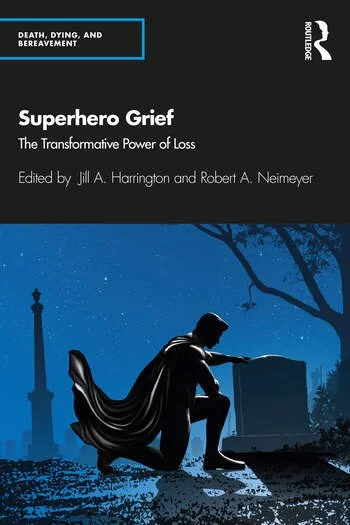
Superhero Grief:
The Transformative Power of Loss
Discovering the Hidden Power of Superheroes in the Journey Through Grief
Loss can change our lives, but it can also reveal strengths we never knew we had.
What can superheroes teach us about navigating life's most difficult losses? Bringing together psychological research, clinical insights, and the powerful symbolism of some of our most beloved heroes, this volume explores how superhero narratives can help us understand the complexities of grief, find meaning in adversity, and envision new possibilities for healing and growth. Featuring perspectives from leading scholars and practitioners, it offers a fresh and compelling approach to understanding the human experience of loss.
Edited by Jill A. Harrington, DSW, LCSW & Robert A. Neimeyer, PhD
Routledge Publishing
Welcome to Superhero Grief: The Transformative Power of Loss, 1st Edition (2021). Superhero Grief is the creative work of Jill A. Harrington in collaboration with Robert A. Neimeyer. The book features esteemed researchers, clinicians, and professionals in the field of Thanatology (the study of dying, death, and bereavement), who address major topics in grief using superhero narratives to explore loss in the context of bereavement and to promote a contextual view of issues and relationship types that can improve coping skills.
Authors use modern superhero narratives, as fictional case studies, to teach the principles of grief theories and concepts and provide practical ideas for promoting healing. Chapters offer clinical strategies, approaches, and interventions, including strategies based in expressive arts and complementary therapies. This volume provides support and psychoeducation to students, clinicians, educators, researchers, and the bereaved while contributing significantly to the literature on the intersection of death, traumatic loss, and grief.
In combination with the book, this website offers additional information from authors, editors and supporters.
Our Mission: A Call to Action - To bring forth, out of the shadows, an esteemed league of thanatologists to help promote a Grief-Informed Society and compassionate care for those at end-of-life and the bereaved.

What people are saying about Superhero Grief: The Transformative Power of Loss
Dedication

In devoted memory of the two complex, flawed, and loving true New York characters who created me, gave me my origin story, influenced my story arc, taught me how to embrace vulnerability as well as call upon the power of strength in the face of adversity.
Elyse Nanni Harrington
(1944-2016)
and
James Dennis Harrington
(1941-2015)
-JAH
-
Senior Editor’s Foreword
Preface
ContributorsIntroduction
Finding Thanos in “Thanatology” and the Transformative Power of the Visual Arts
Jill A. HarringtonPart I: Historical Backgrounds: Grief, Loss and The Creation of Superheroes
Chapter 1: The Rippling Effects of the Holocaust: The Jewish Influence on the Development of Superheroes.
Howard R. Winokuer & Fred C. Fowler
Chapter 2: And Then Came Superman: Parallels with the Man of Steel and His Creators
Jill A. Harrington & Howard R. WinokuerPart II: Understanding Superhero Grief Through Post Modern Grief Theory
Chapter 3: Transformations in the Field of Grief and Bereavement: From Clark Kent to Beyond Kübler-Ross
Christiane Manzella
Chapter 4: Loss and the Heroic Quest for Meaning: A Conversation with Robert A. Neimeyer
Robert A. Neimeyer & Jill A. Harrington Chapter 5: Continuing Bonds Across the Universes: Superheroes and Enduring Connections.
Christopher Hall
Chapter 6: Understanding Grieving Styles: Batman on the Couch
Kenneth J. Doka & Terry L. Martin
Chapter 7: Bruce Wayne, Batman and Attachment-Informed Grief Work
Phyllis KosminskyPart III: Types of Grief: Brief Case Studies of Superheroes
Chapter 8: Deadpool and Anticipatory Grief
Cheryl Hogsten Dodson
Chapter 9: Superman and Secondary Losses
Belinda M. Gonzalez-Leon
Chapter 10: Magneto and Ambiguous Loss
Cori Bussolari
Chapter 11: Batman and Masked Grief
Jon K. Reid
Chapter 12: Wonder Woman and Delayed Grief
Pamela A. Malone
Chapter 13: The Flash and Disenfranchised Grief
William Feigelman, Beverly Feigelman & Justin Colon
Chapter 14: Iron Man and Chronic Grief
Rebecca S. Morse & Jacob Halbert
Chapter 15: Avengers Infinity War and Endgame: Cumulative and Collective Grief
Mark de St. AubinPart IV: Grief and Culture: Cultural Influence in the Superhero Universes
Chapter 16: A Tale of Two Funerals: Funeral Rites, Rituals and Customs Across the Superhero Universes
William G. Hoy
Chapter 17: Black Panther: Exploring Grief, Ancestral Connection and the Duty to Carry-On
Tashel C. Bordere & Marshall AllenPart V": Grief and Family Systems: Superheroes and Relationship Types
Chapter 18: Observations on a Hero’s Response to Homicide
Laura Takacs & Edward Rynearson
Chapter 19: What Drax the Destroyer and Cable Help Us Understand About Grieving Fathers and Survivors of Familial Homicide
Selin Santos & Louis A. Gamino
Chapter 20: Parents and Caregivers: The Everyday Heroes Behind Superheroes
Irwin Sandler & Donna Gafney
Chapter 21: Katana: Spousal Bereavement and Continuing Bonds
Kathleen R. Gilbert & Andy H.Y. Ho
Chapter 22: Sibling Grief and Complex Relationships: Thor and the Death of Loki
Rayna Vaught GodfreyPart VI: Challenges in Bereavement: Facing Adversity
Chapter 23: Deadpool 2 and Suicide After Bereavement: Lessons Learned from the Merc with a Mouth
Jill A. Harrington, Kim A. Ruocco & John R. Jordan
Chapter 24: Complicated Grief, Bruce Wayne and Batman: A Conversation with M. Katherine Shear
M. Katherine Shear & Jill A. Harrington
Chapter 25: Traumatic Loss and How the Flash Could Benefit from Restorative Retelling
Sharon StrousePart VII: Posttraumatic Growth, Superheroes and Personal Stories Addressing the Five Factors
Chapter 26: Posttraumatic Growth, Superheroes, and the Bereaved
Melinda M. Moore
Chapter 27: Relating to Others: In the Aftermath of Loss, I am STORM
Toya Clebourn-Jacobs
Chapter 28: New Possibilities in Life: Superman and Finding Hope after Loss
Gloria Horsley
Chapter 29: Personal Strength: Combat Death, Love, Loss and the Emergence of the Wonder Woman Within
Malia Fry
Chapter 30: Spiritual Growth After Loss: Dr. Strange and My Spiritual Journey Amidst Profound Loss
Brendan Prout
Chapter 31: Appreciation for Life: We Rise Like the Dark Knight
Ashlynne Haycock & Weston HaycockPart VIII
Superheroes, Grief Leadership, Social Justice, and Advocacy
Chapter 32: Grief Leadership: Examples from the Life and Service of Captain America
James A. Martin, David F. Carey & Stephen J. Cozza
Chapter 33: Parental Grief and Activism: On Becoming Your Friendly Neighborhood Spider-man
Joyal Mulheron
Chapter 34: X-Men: What They Teach Us about Oppression and Marginalization of the Bereaved
Erica Goldblatt HyattPart IX: Superhero-based Strategies of Care: Interventions and Creative Approaches
Chapter 35: Avengers Endgame: What It Can Teach Us about Individuals and Families Facing the End-of-Life
Lisa Holland Downs
Chapter 36: Childhood Grief and the Healing Power of Superheroes
Donna Gaffney
Chapter 37: Using Superheroes in Grief Counseling with Children and Adolescents
Rachel A. Kentor & Julie B. Kaplow
Chapter 38: The Superpower of the Expressive Arts
Rebekah Near & Barbara E. Thompson
Chapter 39: Grief and the Masks We Wear: Secret Identities are Not Only for Superheroes
Sharon Strouse and Sarah Vollmann
Chapter 40: Art Therapy Superhero Dolls: Totems of Strength and Remembrance
Sarah Vollmann
Chapter 41: Mindfulness as Your Grief Superpower
Heather StangPart X: Conclusion
Chapter 42: Finding Super Heroes All Around Us
Jill A. Harrington -
Marshall Allen, MPH, BA in Black Studies and Political Science; Certificate in Black Studies, Multiculturalism, and American Constitutional Democracy; Graduate, University of Missouri, Columbia, Missouri.
Tashel C. Bordere, PhD, CT, Assistant Professor, Human Development & Family Science State Extension Specialist, Youth Development, University of Missouri, Columbia, Missouri.
Cori Bussolari, PsyD, Associate Professor, Licensed Psychologist, Marriage and Family Therapy Program, Counseling Psychology Department, University of San Francisco, California.
David F. Carey, MS, BS, LTC, U.S. Army (Retired), Combat-Veteran (OIF/OEF); National Security Contractor, U.S. Department of Defense, Springfield, Virginia.
Toya Clebourn-Jacobs, DSW, LMSW (Surviving Spouse, Honoring Jamie Ranell Jacobs), Public Assistance Emergency Management, Spring, Texas.
Justin Colon, Baccalaureate student, John Jay College of Criminal Justice, New York, New York.
Stephen J. Cozza, MD, DFAACAP, DFAPA, COL, U.S. Army (Retired), Professor of Psychiatry and Pediatrics, Senior Scientist, Center for the Study of Traumatic Stress, School of Medicine, Uniformed Services University of the Health Sciences, Bethesda, Maryland.
Cheryl Hogsten Dodson, DNP, MBA, RN, CCM, Assistant Professor of Nursing, Department of Nursing, Methodist University, Fayetteville, North Carolina.
Kenneth J. Doka, PhD, MDiv, Professor Emeritus, the Graduate School of the College of New Rochelle, New York; Senior Consultant to the Hospice Foundation of America; Author of over 40 books.
Lisa Holland Downs, RN, MSN, FNP-BC, Medical Science Liaison, GENENTECH A Member of the Roche Group, Rockledge, Pennsylvania.
Beverly Feigelman, MSW, LCSW, Private Practice Psychotherapist, Jamaica Estates, Queens, New York.
William Feigelman, PhD, Professor Emeritus of Sociology, Nassau Community College, Garden City, New York.
Fred C. Fowler, MD, MBA, Partner, Carolina Digestive Health Associates, Charlotte, North Carolina.
Malia Fry (Surviving Spouse, Honoring GySgt John D. Fry, USMC), Baccalaureate student, University of Mary Hardin-Baylor, Belton, Texas.
Donna Gaffney, DNSc, FAAN, psychotherapist (specializing in loss, grief and trauma among children and families), educational consultant, and founder of DAGaffney Consulting LLC, in Morristown, New Jersey.
Louis A. Gamino, PhD, ABPP, FT, Professor (Affiliated) of Psychiatry & Behavioral Science at Texas A&M Health Science Center College of Medicine and Baylor Scott & White Health in Temple, Texas; ADEC Clinical Practice Award (2008).
Kathleen R. Gilbert, PhD, FT, Professor Emerita of Applied Health Science, Indiana University School of Public Health, Bloomington, Indiana.
Rayna Vaught Godfrey, PhD, Licensed Psychologist, Private Practice (focus on grief, loss and sibling bereavement), Wesna, LLC, Jacksonville, Florida.
Erica Goldblatt Hyatt, DSW, LCSW, MBE, Assistant Director of the DSW Program, Assistant Teaching Professor, School of Social Work, Rutgers, the State University of New Jersey, New Brunswick, New Jersey.
Belinda M. Gonzalez-Leon, EdD, MBA (Surviving Spouse, Honoring Alfredo Leon), Premier Educational Consulting, Miami, Florida
Jacob Halbert, MS, PsyD, Institute for the Psychological Sciences, Divine Mercy University, Sterling, Virginia.
Christopher Hall, MA, GradDipAdol&ChPsych, BED, CertIVTAE, Chief Executive Officer, Australian Centre for Grief & Bereavement, Mulgrave, Australia.
Jill A. Harrington, DSW, LCSW, Private Practice, Harrington Consulting & Counseling Services, Occoquan, Virginia; Adjunct Assistant Professor, The Chicago School of Professional Psychology, Washington DC; Part-time Lecturer, Rutgers University School of Social Work, New Brunswick, New Jersey.
Ashlynne Haycock, BS (Surviving Adult Child, Honoring SFC Jeffrey Haycock, USA & SrA Nichole Haycock, USAF Veteran), Deputy Director, Policy, Tragedy Assistance Program for Survivors, Arlington, Virginia.
Weston Haycock, BA (Surviving Adult Child, Honoring SFC Jeffrey Haycock, USA & SrA Nichole Haycock, USAF Veteran), U.S. Senate Staff Assistant, Washington, DC.
Andy H.Y. Ho, PhD, EdD, MFT, FT, Associate Professor of Psychology, School of Social Sciences& Joint Honorary Associate Professor, Lee Kong Chian School of Medicine; Deputy Director of Research, Palliative Care Centre for Excellence in Research and Education; Founding Director, Action Research for Community Health, Nanyang Technological University Singapore.
Gloria Horsley, PhD, RN (Bereaved Parent, Honoring Scott Horsley), Founder and President, Open to Hope Foundation, Palo Alto, California.
William G. Hoy, DMin, FT, Clinical Professor of Medical Humanities, Baylor University, Waco, Texas; Former Clinical Counseling Director, Pathways Volunteer Hospice, Long Beach, California.
John R. Jordan, PhD, Licensed Psychologist, Retired from Private Practice, Pawtucket, Rhode Island; Developer and Lead Trainer of American Foundation for Suicide Prevention Suicide Bereavement Clinician Training Program; Former Clinical Consultant for Grief Support Services of the Samaritans, Boston, Massachusetts.
Julie B. Kaplow, PhD, ABPP, Director, Trauma and Grief Center, Hackett Center for Mental Health, Houston, Texas.
Rachel A. Kentor, PhD, Assistant Professor, Department of Pediatrics, Baylor College of Medicine Psychology Service, Texas Children's Hospital, Houston, Texas.
Phyllis Kosminsky, PhD, LCSW, FT, Private Practice, Westchester, New York; Psychotherapist, The Center for Hope/Family Centers, Darien, Connecticut; Adjunct Faculty, Fordham University School of Social Services, New York.
Pamela A. Malone, Ph.D., LCSW-S, FT, Assistant Professor-in-Practice, University of Texas at Arlington School of Social Work, Arlington, Texas; Clinical Supervisor; Private Practice, Blue Lapis Consulting, PLLC, Austin, Texas.
Christiane Manzella, PhD, Senior Psychologist, Seleni Institute, New York, New York; Professor, New York University, New York, New York.
James A. Martin, PhD, COL, U.S. Army (Retired), Professor of Social Work and Social Research, Bryn Mawr College, Bryn Mawr, Pennsylvania.
Terry L. Martin, PhD, former Associate Professor, Hood College, Frederick, Maryland; Private Practice (specializing in dying and grief-related issues); Hospice and Nursing Home Consultant.
Melinda M. Moore, PhD, Licensed Psychologist, Assistant Professor, Department of Psychology, Eastern Kentucky University, Richmond, Kentucky.
Rebecca S. Morse, PhD, Associate Professor, Director of Research Training, Institute for Psychological Sciences, Divine Mercy University, Sterling, Virginia.
Joyal Mulheron, MS, Founder & Executive Director, Evermore, Washington, DC.
Robert A. Neimeyer, PhD, Professor Emeritus, University of Memphis, Memphis, Tennessee; Director, the Portland Institute for Loss and Transition, Portland, Oregon; Private Practice and Coaching; Editor of Death Studies; Author of over 500 journal articles and book chapters as well as 30 books.
Brendan Prout, MDiv, CTC, CGC, CISR (Surviving Adult Child, Honoring RADM James G. Prout III), Worship Pastor, Quest Church, San Diego, California.
Jon K. Reid, PhD, Professor, Southeastern Oklahoma State University, Durant, Oklahoma.
Mark de St. Aubin, LCSW, FT, Director of Community Education, Serenity Funeral Home, Draper, Utah.
Kim A. Ruocco, MSW, Vice President, Suicide Postvention & Prevention, Tragedy Assistance Program for Survivors, Arlington, Virginia.
Edward Rynearson, MD, Medical Director, Virginia Mason Medical Center, Grief Services, Seattle, Washington; ADEC Research Recognition Award (2015).
Rebekah Lancto Near, CAGS, MS, LCAT, consulting licensed expressive arts therapist for Friends of Karen, Inc., Brooklyn, New York.
Irwin Sandler, PhD, Regents Professor Emeritus and Research Professor with the REACH Institute and the Department of Psychology, Arizona State University, Tempe, Arizona.
Selin Santos, PsyD, Licensed Clinical Psychologist, Department of Hematology and Medical Oncology, Cleveland Clinic, Weston, Florida.
M. Katherine Shear, MD, Marion E. Kentworthy Professor of Psychiatry, Columbia University School of Social Work, Columbia University College of Physicians and Surgeons, Director, Center for Complicated Grief, New York, New York.
Heather Stang, MA, C-IAYT, Yoga Therapist, The Mindfulness & Grief Institute, Hagerstown, Maryland.
Sharon Strouse, MA, ATR-BC, LCPAT, Associate Director, The Portland Institute for Loss and Transition; Private Practice, Art Therapist; Co-founder, The Kristin Rita Strouse Foundation, Baltimore, Maryland.
Laura Takacs, LICSW, MPH, Clinical Director, Virginia Mason Medical Center, Grief Services, Seattle, Washington.
Barbara E. Thompson, OTD, LCSW, Professor, Russell Sage College, Troy, New York.
Sarah Vollmann, MPS, ATR-BC, LICSW, Private Practice (specializing in bereavement) and Lead Counselor at Buckingham Browne & Nichols School in Cambridge, Massachusetts.
Howard R. Winokuer, PhD, FT, Grief Educator, Speaker, Consultant and Editor; ADEC Clinical Practice Award (2017); Private Practice, Founder, The Winokuer Center for Counseling and Healing, Charlotte, North Carolina.
-
Jill A. Harrington, DSW, LCSW is an Adjunct Professor for the Chicago School of Professional Psychology, Washington DC Campus as well as a Part-Time Lecturer for Rutgers University School of Social Work. Dr. Harrington also maintains an active clinical counseling practice in the Greater Washington DC Area. She earned her Doctorate in Social Work from The University of Pennsylvania School of Social Policy & Practice, Philadelphia, PA and is one of the first published authors on the subject of bereavement in U.S. military families. She has been a practicing social worker for over twenty years and has had a special focus on trauma, loss and bereavement. Dr. Harrington is a former Senior Director of Field Research for Uniformed Services University of the Health Sciences (USUHS) Center for the Study of Traumatic Stress (CSTS), Bethesda, Maryland and has been a consultant to Columbia University Center for Complicated Grief. Dr. Harrington is active on many national and international committees and working groups, addressing bereavement, clinical practice and grief awareness and education. She is a member of The National Association of Social Workers, The American Association of Suicidology as well as a former Board Member (2011-2014) for the Association for Death Education & Counseling and currently serves as the Chair of the Conference Committee, Concurrent Program. In her career, she has published numerous peer-reviewed articles and book chapters. She is the creator and lead editor of the new, creative textbook, entitled, Superhero Grief: The Transformative Power of Loss (2021), published by Routledge.
Email: drjillharrington@gmail.com
Robert A. Neimeyer, PhD, is Professor Emeritus of the Department of Psychology, University of Memphis, and maintains an active consulting and coaching practice. He also directs the Portland Institute for Loss and Transition, which provides training internationally in grief therapy. Since completing his doctoral training at the University of Nebraska in 1982, he has conducted extensive research on the topics of death, grief, loss, and suicide intervention.
Neimeyer has published 30 books, including Techniques of Grief Therapy: Assessment and Intervention and Grief and the Expressive Arts: Practices for Creating Meaning, the latter with Barbara Thompson. The author of over 500 articles and book chapters, he is currently working to advance a more adequate theory of grieving as a meaning-making process, both in his published work and through his frequent professional workshops for national and international audiences.
Neimeyer is the Editor of the respected international journal, Death Studies, and served as President of the Association for Death Education and Counseling. In recognition of his scholarly contributions, he has been granted the Distinguished Research Award, the Distinguished Teaching Award, and the Eminent Faculty Award by the University of Memphis, elected Chair of the International Work Group on Death, Dying, and Bereavement, and given the Research Recognition, Clinical Practice and Lifetime Achievement Awards by the Association for Death Education and Counseling. Most recently, he has received the Phoenix Award: Rising to the Service of Humanity from the MISS Foundation, been given ADEC’s Lifetime Achievement Award, and been recognized as an Honored Associate of the Viktor Frankl Association for his lifetime contributions to the study of meaning.